by Steven Litt / Plain Dealer Art Critic
Tuesday September 09, 2008, 3:29 PM
Chris Stephens/The Plain Dealer
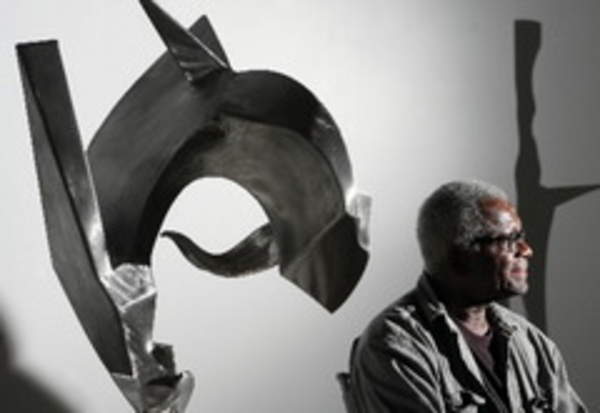
Chicago sculptor Richard Hunt on his work: "I think in metal. The ideas just come to me."
Chicago sculptor Richard Hunt, whose abstractions in metal have earned acclaim for decades, finds inspiration everywhere. "How a branch is bent by the wind, a wing in movement -- all those things are part of the sculptural vocabulary," he said Friday at the Sculpture Center in Cleveland, hours before the opening of a new show on his work. It focuses on small welded metal piece that he created over the past decade, many of them maquettes, or studies, for larger monumental commissions intended for cities across the United States.
"I've been interested in everything," he continued. "Certainly [human] figures and trees are things I look at all the time."
But as he works with his welding torches and tools, his sculptures mutate and take on strange, surreal, hybrid qualities. Organic forms become mechanical, or vice versa. Solid forms take on liquid qualities.
"When they're rendered in metal, the sources are synthesized into a metallic construction," he said. "What starts out as a leaf can become a flame."
The Sculpture Center show, organized by director Ann Albano, is a revelation, and one of the best sculpture exhibitions in Cleveland in recent memory.
Hunt, 72, is an art-historical survivor. He is one of the last major living exponents of Abstract Expressionism, which reached its apex in the 1950s, when Hunt was in his 20s.
The movement, which emphasized direct expression of emotions through dancelike, gestural forms, was superseded quickly in the 1960s by the sardonic detachment of Pop Art, the cool intellectuality of Minimalism and Conceptual Art, and a cascade of movements and isms that followed.
Yet Hunt has continued for decades to make abstract sculptures whose fluid and flamelike forms recall the splashy brushstrokes of painters such as Willem de Kooning or the spatters of Jackson Pollock. He speaks reverently of American Abstract Expressionist sculptors such as Herbert Ferber and Seymour Lipton, who fired his imagination years ago, along with the works of Pablo Picasso and the Spanish abstractionist Julio Gonzalez.
As he soldiered on, Hunt carried his audience with him, winning commissions for large-scale public sculptures from Chicago to Atlanta and earning a place for his works in dozens of museum collections.
"Over this period of time, people reject your work and find you old hat, but then other people discover you," he said. "There are people for whom this vocabulary is a dialect they understand."
As a black artist, Hunt has had his share of breakthroughs. He was the first African-American artist, for example, to have a major solo exhibition at the Museum of Modern Art in New York, in 1971.
He's proud of being a path-breaker. Today, however, Hunt considers the experience of being black in America to be "only a small window on a narrow band of the total experience of people of African descent in the world."
At the Sculpture Center, two galleries are filled with more than two dozen sculptures whose flowing and spiky metal forms bring to mind a thousand associations. They evoke pelvic bones or spines, flower petals or tongues of fire, thorns or a clenched fist or a swirl of smoke. Filled with joy, they communicate the liberating sensation that Hunt could go on forever, never running out of ideas.
"It's just like you learn a language -- you start to think in it," he said. "I think in metal. The ideas just come to me."
Dressed in loose-fitting work clothes, Hunt resembled a construction worker, except that his black, horn-rimmed glasses gave him an intellectual air. Gregarious and relaxed, he projected a boyish energy, despite having just driven six hours from Chicago in the navy blue GMC Suburban he uses for hauling sculpture and equipment.
Born in Chicago in 1935, he was encouraged by his parents, especially his mother, to study art. He excelled in classes at the Art Institute of Chicago as a child and quickly gained notice after earning a college degree there. After serving in the Army and a brief stint as a teacher, he realized he could make more money selling sculpture and quit the classroom. It all came naturally.
"You don't start out saying, 'I'm going to be an artist.' You just like doing it, so you do it."
Since 1971, Hunt has lived near DePaul University in the Lincoln Park neighborhood, in a two-story brick building built in 1909 as an electrical substation for the Chicago railway system. Once on the fringe, the area is now fashionable and upscale.
"My only problem is capital gains," Hunt said with a grin.
The artist describes his personal life as "married and divorced, married and widowed, married and divorced. I'm through with all that and taking a break."
His career is going well. He's got four to five commissions under way or recently completed in Chicago, East St. Louis and Libertyville, Ill.; Muskegon and St. Joseph, Mich.; and Newport News, Va.
"A lot of projects I'm doing are related to cities trying to renew themselves and feeling like art ought to be a part of it," he said.
Hunt has many ties to Cleveland. He used to have bronze sculptures cast at the Light Sculpture Works foundry in the Flats. The Cleveland Museum of Art owns numerous drawings and two of his sculptures; a third was commissioned years ago for the Justice Center in downtown Cleveland.
The administration of former Mayor Michael White asked him to create a monument at Settler's Landing on the east bank of the Flats, but the job fell through. Hunt said he never found out why.
Hunt doesn't worry about how art history will treat him in the future. He's happy to be considered a major African-American artist, but his work also reveals a multitude of other connections, beyond Abstract Expressionism, that include deep roots in Chicago. It's possible, for example, to see his interest in nature as a continuation of the Organic architecture of Louis Henri Sullivan and Frank Lloyd Wright.
At the heart of his work, though, lies a perpetual struggle to keep up with his own imagination. He does it, literally, by bending metal to his will as quickly as he can manage.
"The ideas come so quickly," he said, "that it's hard to keep up with it."
 Posted By: Daniel Moss
Wednesday, September 10th 2008 at 10:29PM
You can also
click
here to view all posts by this author...