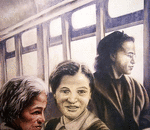
Kristen Hayes is an artist and art teacher in Washington DC. Measurable Advancement had the opportunity to interview Ms. Hayes and gain further insight into her passion for art education, how it could be better utilized and much more. So put on your thinking caps, because after this interview, you will never view art education the same!
Measurable Advancement: Generally speaking, there seems to be a low priority placed up art education in this era of high-stakes testing, how do you feel about that?
Kristen Hayes: With regards to testing, the kids are definitely overly tested and not given enough time for personal exploration. Art education fuels the self-expression that comes from personal exploration. Self-expression that guarantees a more confident, analytical, cognitive-thinking student; which contributes to a more developed and intelligent young person. We can all agree that the core subjects are vital to a child’s academic development, but the use of art education as a tool in this area, is being neglected in most school systems. However, things are changing. According to the International Society for Education Through the Arts:
It is important to respect artistic values and deepen understanding in arts and culture by expressing oneself and actually see and feel a wide variety of arts and culture also in the sense of the creation of children’s own arts and culture. We need to reconsider the significant effects of children’s imagination on the development of their cognitive abilities and redesign the learning environment that is more flexible and full of creativity.
So, around the world, people are realizing the need for a shift from traditional perspectives.
MA: You are an artist / painter as well as an art teacher – how is teaching an extension of your creativity?
KH: Learning how to teach art is still very much a process for me. For every new project, every new group of students, I am inspired and required to investigate the content on a deeper level. It’s my job to do so, if I want to transfer the information to my students in a meaningful and exciting way. So I take this level of understanding home with me and translate it to my own work. As I am teaching the students, I am remembering and retraining myself of the foundations of art that I sometimes overlook or forget were important elements and principles that should be considered for a successful work of art.
Also, my teaching is literally becoming a part of my work in a recent group of work, entitled “Sunlight Kids”, where I am creating a collage of images of students in their uniforms and placing them amidst my abstract environments. The focus is not only the abstract forms, but also the students’ very striking gestures. Within these gestures is seen such power and resilience; two traits that are often ignored and not supported enough with African-American children. I want to encourage this attitude of self-confidence and joy in life with this current series of work. My students are helping me to achieve that goal.
MA: If you had a your own “Art Education Stimulus Package” – in what ways would you change/ enhance art education?
KH: Wow, I would definitely start with the District of Columbia’s Public School System obtaining real art supplies for every art classroom, equipped with sinks, storage rooms, and proper seating and desks. How can you teach if you don’t have the means with which to do so? And I’m sure other major cities face shortages in supplies when it comes to art classrooms.
Secondly, I would make more scholarships available to college students who want to pursue Art and Art Education. Since art education is such a vital component to a child’s personal and academic development, such incentives should be available and promoted for those who might otherwise not consider art education as a career choice.
MA: Have you had experience “reaching” otherwise underperforming students? Tell us about it …
KH: There is a sixth grader that comes to mind when I think about a student who is bright, but slow at applying their knowledge in the classroom. I’ve come to understand that with this child, there is a lot of insecurity about decision-making. With the mandalas, which is a spiritual tool based in the Hindu religion that we are currently working on now, I found this student, who is usually more stubborn and unresponsive, to be quite informed about the use of the microscopes that we used to examine our natural specimens, and joined others in explaining their proper usage. Once we got to the part of personally designing our mandalas, this same student became frustrated over his work, thinking that it was not successful and incorrect. This was definitely a teaching moment for me, because now I had his attention and the opportunity to pinpoint exactly where his insecurity lay, and boost his confidence by enforcing the idea of self-expression. There is no right or wrong answer in artistic expression! Apparently, this child did not have enough chances where his opinion and choice in matters was seriously considered or desired. As soon as he realized that he was indeed on the right track, I couldn’t get him out of the classroom! All of a sudden, the light came on for a student who was stuck in the mud of self-doubt, and now he wanted to see his project through to the end because he now knew how great it would be.
MA: When did you know this was your calling?
KH: Teaching art is part of my sacred work, my spiritual contribution to the universe. I have always been the type to mentor and care for children, but thought because of my shyness and lack of experience in education that I could not be an affective instructor. And I still think years of life’s experience aids in being a more influential teacher, but as I grew more confident in my own work and with the prompting of several artist-friends who teach also, I took a chance and tried it out, beginning with just one class a week. But I’ve always been interested in the arts, and come from a family of very creative people. By my sophomore year in undergraduate school, I realized that life is too short not to pursue an area that is such a part of who I am as a person. Being an artist is not just something one does, it is a way of life. There are so many people in the world who are artists, just by the way they present themselves and interact in life’s situations. There’s freedom in creative thinking and living.
MA: We absolutely agree. Do you have a philosophy when it comes to Art Education?
KH: In my class, I stress the utilization of having a positive attitude towards your peers, as well as yourself and your personal work. Because I view the process of creating art as a healing mechanism, there is no room for negativity. In this way, the positive energy allows for more personal freedom in the artwork and less feelings of intimidation and doubt. Research informs us of how students in earlier grades “…could produce such convincing effects with small pictorial resources because they would venture to try anything that came to mind…” (Logan) In contrast, those of whom were at the beginning of adolescence displayed feelings of insecurity as to what one should draw. It is my goal to foster this same sense of freedom, from early childhood and hopefully beyond adolescence, and believe the classroom environment and overall school’s spirit plays a vital role in this becoming a reality. I am an Abstract artist who focuses on the healing aspect of art through positive energy. Therefore, I would naturally extend this belief system into my classroom. Color, symbolism, light, all contribute to my expression of spiritual connectivity, which is the ultimate source of positivity. Color relationship is significant in my work, due to the very real vibrations felt with certain color combinations. In quilting, the colors are referred to as “hitting” when they simply just work. I stress my enthusiasm for color theory and hope to have it shared and experienced by the students.
To remain an individual within a group setting is an idea supported by the existential philosopher, Friedrich Nietzsche, and one that I have adopted as part of my personal agenda as an art instructor. Through his observations, he found that most teachers and parents “hammer even into children that what matters is something quite different: the salvation of the soul, the service of the state, the advancement of the science…while the requirements of the individual…are to be regarded as something contemptible or a matter of indifference.” To create art is allowing for an opportunity to be alone with one’s thoughts, something a lot of younger students take for granted when being constantly bombarded by popular society (i.e., video games, television, music videos, advertisements on the streets, etc.) Visually, urban areas of the country are overwhelmed by “art trash”—several thousands of different visual ideas being thrust into one’s psyche, whether consciously or unconsciously. The process of creating your own personal expressions of thought gives you a setting in which to digest all that you have been forced to consume. Herein lies the evidence of critical thinking and analysis that presumably only occurs in the general education classrooms.
posted by advanceAdmin
 Posted By: Daniel Moss
Friday, October 2nd 2009 at 4:20PM
You can also
click
here to view all posts by this author...