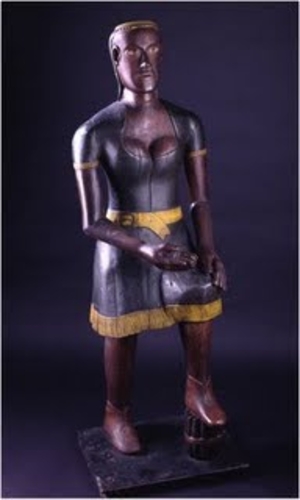
This is another in a series of posts about the great folk art pieces included in the Fenimore Art Museum’s traveling exhibition Through the Eyes of Others: African Americans and Identity in American Art, which is on view at the New York State Museum in Albany through January 6, 2010. This exhibition is curated by Dr. Gretchen Sullivan Sorin, Director of the Cooperstown Graduate Program, who, by the way, has just been awarded the prestigious Katherine Coffey Award from the Mid-Atlantic Association of Museums. Unlike the first sculpture I discussed in my August 31 post, which was a depiction of a black man by a white artist, this piece was created by an African American carver.
Our “African American Cigar Store Figure” was found in Freehold, New Jersey in the mid-20th century. According to local tradition, it was carved in about 1825 by a freed slave named Job. This has never been substantiated, but the piece itself presents some compelling physical evidence that strongly suggests that it is the product of a black folk artist.
First, it is not made like any other known cigar store figures carved by white artists (many of them German immigrants) in American urban centers in the mid-19th century. These figures were usually made by sectioning off a length of solid log (usually pine, which was straight-grained: old ships’ masts were ideal for this purpose) and carving the figure’s body and head. The arms, which often extended outward, would be carved separately and joined to the body. Job’s figure is not made this way at all. Instead, the artist carved and joined thirteen separate pieces of wood to form the body and its appendages. The precision of the joinery suggests that Job may have mastered the craft of cabinetmaking, a trade he would have shared with numerous African Americans of his time.
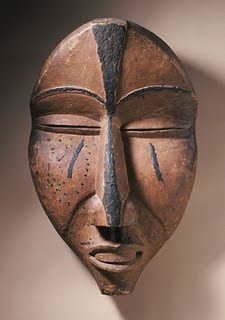
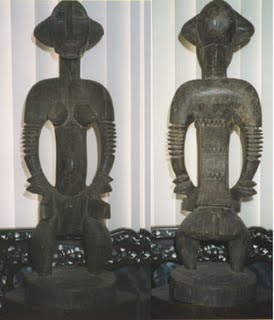
Second, this figure does not look like any other known cigar store figure. The torso and arms are boldly stylized into angular, geometric shapes. Likewise, the face is flattened and mask-like. The vast majority of cigar store figures were naturalistic carvings with faces that were either brutally savage or idealized with Anglo-American features. Since our figure’s discovery and publication in the 1940s, numerous scholars have noted these distinctly African stylistic traits, as seen in the examples of African art at above left and right.
The folk art scholar and collector Michael D. Hall (whose collection is in the Milwaukee Art Museum) often used our Job figure to illustrate how the best American folk art was represented by those rare pieces that were within an established visual tradition yet displayed an individual’s stamp of creativity and innovation. I can’t help but agree. But there is also something about this figure that is quintessentially American in the delicate balance between this former slave’s cultural memory and his social, economic, and artistic aspirations.
Posted by Paul D'Ambrosio
 Posted By: Daniel Moss
Monday, September 14th 2009 at 3:15PM
You can also
click
here to view all posts by this author...